

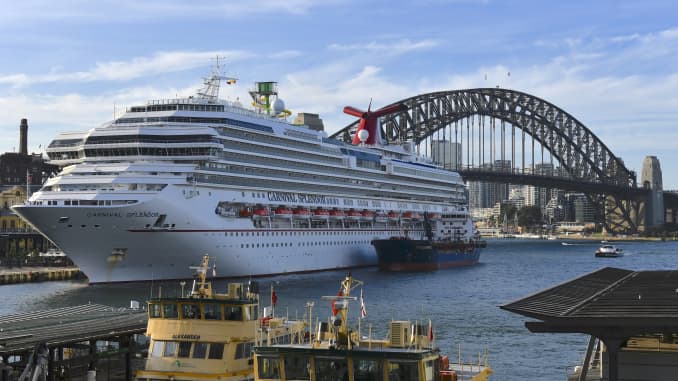
The COVID-19 outbreak has laid waste to entire sectors of the global economy, but none faster than the cruise industry. The pandemic has basically shut down the cruise-ship business, with the three largest publicly traded cruise companies suspending some, if not all, of their operations.
Carnival, the world’s largest cruise operator, has been at the heart of the industry’s struggle against the coronavirus. COVID-19 has spread on ships across nearly half of its brands, infecting hundreds of passengers and killing others.
Shares of Carnival are down more than 80% in 2020 alone, and the company said in a securities filing that it couldn’t predict when any of its ships would begin to sail again or when ports would reopen.
Yet, time after time, Carnival has proven resilient, despite seemingly insurmountable setbacks. The company has experienced everything from norovirus outbreaks to fires and capsizes, and it’s still bounced back after every crisis.
Some experts say this time it’s different.
For one thing, the government has effectively temporarily cancelled an entire industry. The State Department has advised that no American should set foot on a cruise ship. The Centers for Disease Control and Prevention, which typically issues health warnings about certain regions of the world, not forms of transportation, has warned travelers against all cruise travel worldwide.
“In over 30 years, it’s unprecedented. We’ve never seen these types of warnings really ever,” said cruise industry expert Stewart Chiron.
Also different this time around — unlike past viral outbreaks aboard ships — passengers have been forced to quarantine on an unprecedented scale either in their rooms on the ships or at U.S. military bases after disembarking.
Carnival is rapidly hemorrhaging money, and so far, the U.S. government has made it clear that it won’t be helping to bail them out. The question now: Is Carnival too big to fail?
Why Carnival keeps rebounding
Shares of the three largest publicly traded cruise line companies — Carnival, Royal Caribbean, and Norwegian — are all down more than 80% so far this year, putting the valuations of the big three at multiyear lows.
Carnival and Royal Caribbean did not respond to CNBC’s requests for comment, and Norwegian declined to comment.
Carnival is no stranger to calamity, and when its stock price has taken a hit, it has shown it can recover.
Over the years, the company has faced every disaster you can envision, from viral outbreaks, to colliding ships, flooding, and fires. But perhaps its two biggest scars are the sinking of the Costa Concordia off the Italian coast in 2012, killing 32 passengers, and an engine-room fire that left the Carnival Triumph without power for days, causing toilets to backup and human waste to overflow into rooms and hallways. That so-called “poop cruise” gripped global media.
0 Comments